For years, a memorable claim has circulated in the thorium community:
A sphere of thorium small enough to fit in your hand could power one person’s entire energy needs for a century
It’s a simple way to illustrate just how much energy is stored in heavy nuclei, and why molten salt reactors have long been seen as a path to deep-energy abundance.
We revisited that claim with updated assumptions, using today’s global average energy consumption rather than older high-consumption European figures. The goal is not a detailed calculation, but a reality check that keeps the idea accessible.
Checking the claim with today’s world
If you take the average amount of energy a person relies on each year — electricity, heating, transport, industry and everything embedded in modern life — and stretch it across a hundred years, the total is large. Yet when you convert that demand into the nuclear energy released through fission, the required thorium mass remains surprisingly small.
In a perfect scenario where every atom is fully used, the thorium ends up as a sphere smaller than a golf ball. Add reasonable real-world factors like thermal conversion losses and incomplete fuel burnup, and the sphere grows modestly, but still stays in the golf-ball range. The intuitive picture holds.
Global primary energy consumption by source
Looking ahead to a higher-energy future
A world running on clean, compact thorium power will likely use far more energy per person than today: electrified industries, synthetic fuels, desalination, automated agriculture and climate remediation all demand steady, abundant power. If global average consumption were to double or triple, the thorium required per person simply scales with it.
Even with those expanded futures, and even when including system inefficiencies, the “lifetime thorium budget” per person remains around a kilogram or less. In physical terms, that corresponds to a metallic sphere only a few centimetres across. You still end up holding a century of prosperity in one hand.
Why this matters
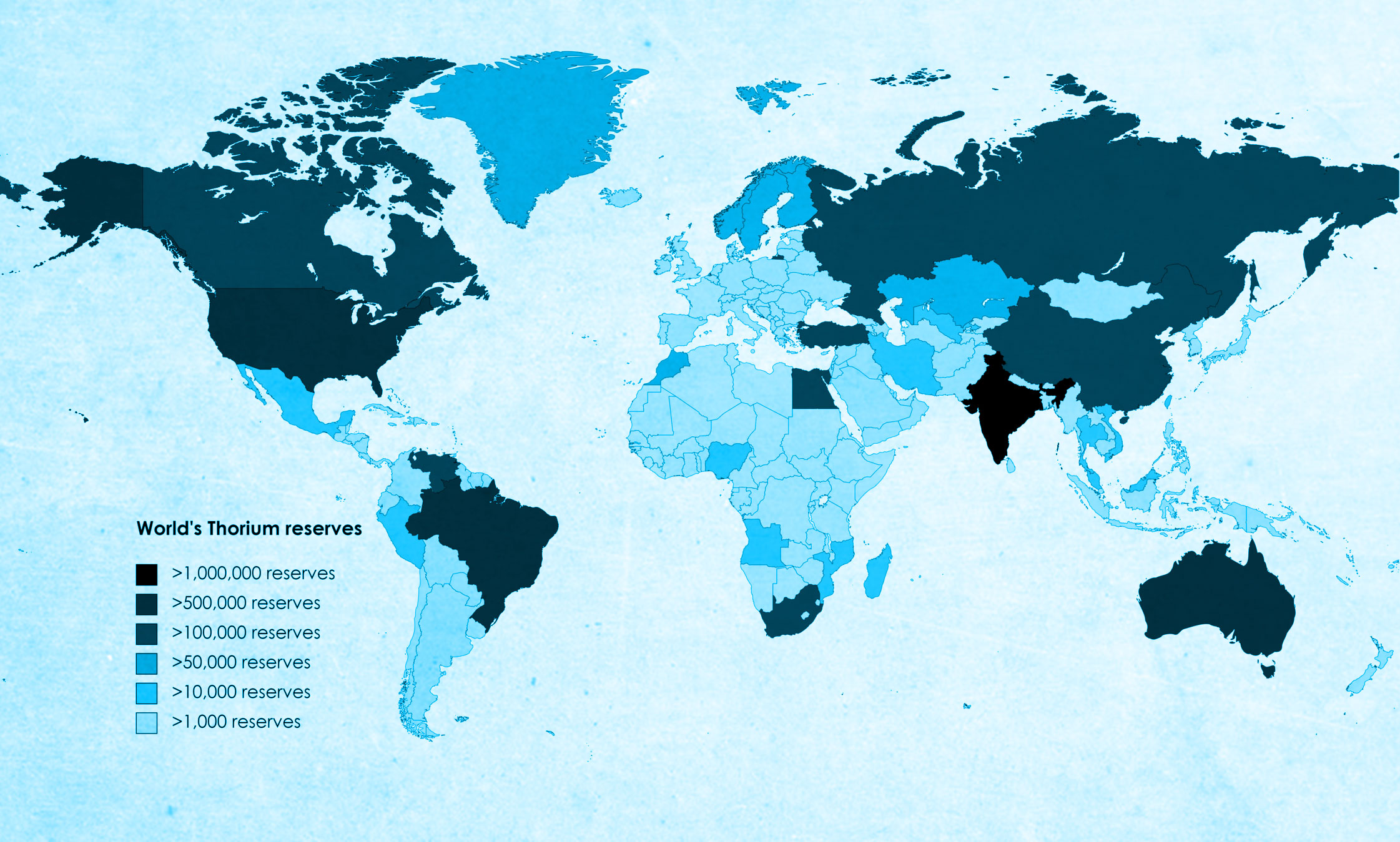
The point isn’t the exact diameter of the sphere, but what it represents. Fission releases so much energy per atom that an advanced reactor fuel cycle compresses a human lifetime of energy into a volume smaller than a tennis ball. This is why thorium resources stretch for millennia and why molten salt reactors are seen as a route to true energy abundance.
Rechecking the old claim with global data and future scenarios shows that the core idea remains intact: thorium’s energy density is extraordinary, and it provides a compelling foundation for a high-energy, low-carbon world.